DiTSG: Context-Aware Air Traffic Scene Generation with Multi-Agent Diffusion Transformers

1George Washington University, 2Korea Aerospace University

Abstract

Understanding how many aircraft, and which traffic configurations, can be safely and efficiently managed by air traffic controllers within a given airspace is fundamental to air traffic management. Air traffic controllers continuously modify aircraft trajectories through interventions such as speed advisories and radar vectoring, and the patterns of these interventions are difficult to capture effectively using existing air traffic simulators. To address this limitation, we propose Diffusion Transformers for Traffic Scene Generation (DiTSG), which learns to generate air traffic scenes from recorded multi-aircraft trajectories. DiTSG employs stacked multi-agent inverted Transformer layers as the denoising backbone of a diffusion transformer, jointly generates the trajectories of multiple aircraft within a traffic scene, and conditions the generation on agent-specific required times of arrival. The resulting trajectories generated by DiTSG preserve realistic inter-aircraft interactions observed in actual air traffic operations. Experiments show that the DiTSG generates diverse traffic scenes that reproduce the statistical properties of recorded traffic while preserving realistic inter-aircraft interactions.

Overview

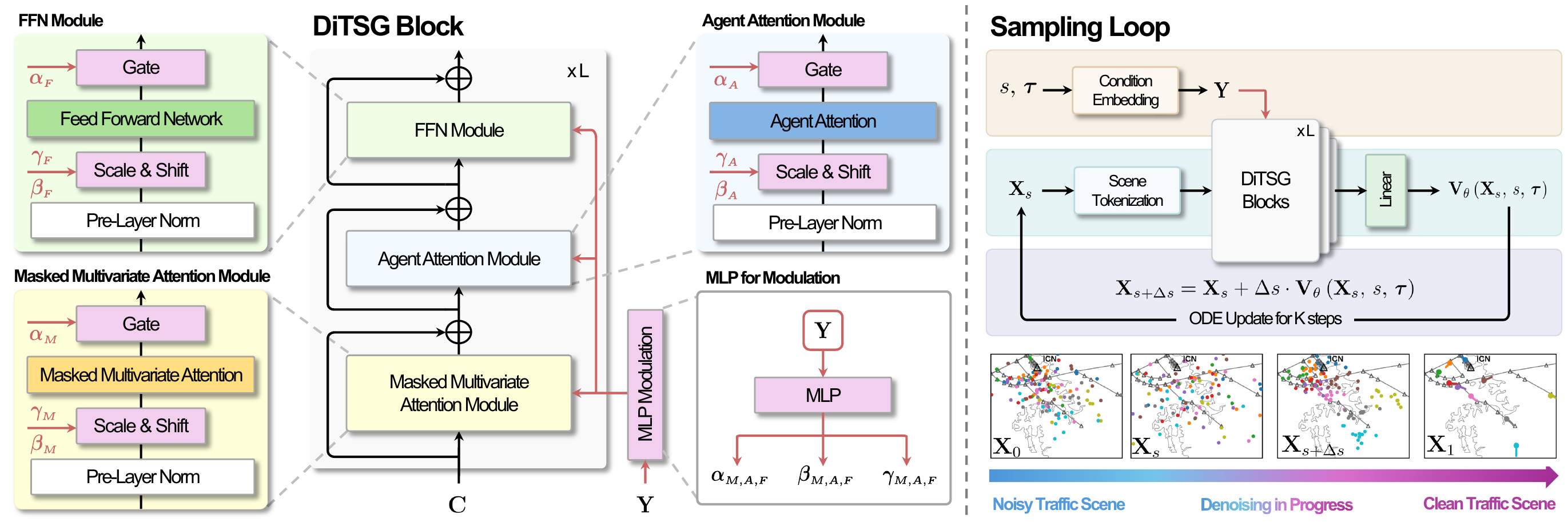
DiTSG architecture: DiTSG block and sampling loop.

We propose Diffusion Transformers for Traffic Scene Generation (DiTSG), a context-aware generative model for multi-agent air traffic scenes, where all aircraft trajectories are generated jointly and each trajectory is modeled in the context of the others. DiTSG employs stacked multi-agent inverted Transformer (MAIFormer) [Yoon et al., 2026] layers as the denoising backbone of a diffusion transformer. Generation is further conditioned on agent-specific required times of arrival (RTAs), enabling different temporal traffic configurations. Starting from noise, DiTSG iteratively refines the trajectories of all aircraft in a scene while modeling inter-aircraft dependencies at every denoising step. This joint denoising process enables the generated trajectories to remain mutually consistent while preserving realistic traffic interactions.

Generated Traffic Scenes with Varying Numbers of Aircraft

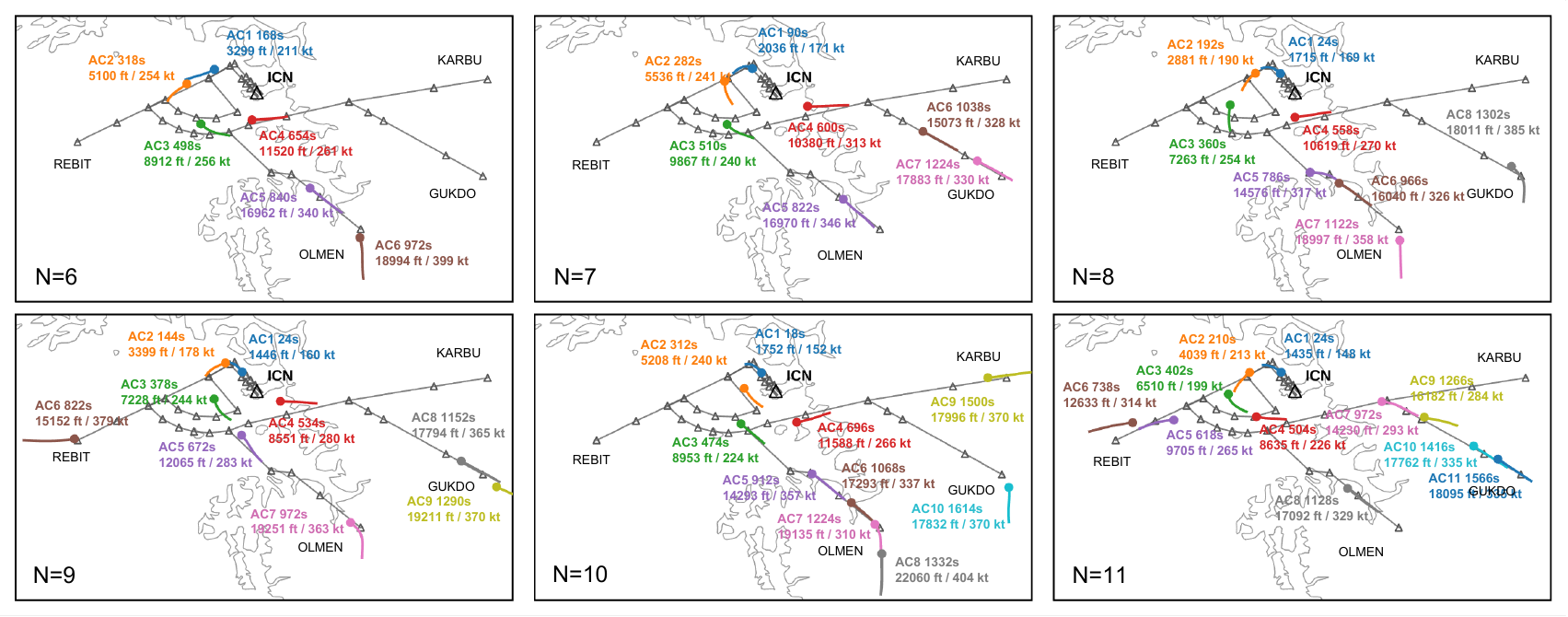
Generated traffic scenes for six to eleven simultaneous aircraft.

Across all panels, DiTSG distributes aircraft over the four arrival fixes (REBIT, OLMEN, GUKDO, and KARBU), although the conditioning does not specify which fix to use. The scenes also show coherent arrival sequencing: aircraft with earlier RTAs are closer to the runway, lower, and slower. Even when deviating from the standard terminal arrival routes (STARs), aircraft form common arrival flows consistent with traffic organization through ATC vectoring. This suggests that DiTSG captures not only the spatial distribution of traffic but also operational patterns induced by ATC vectoring.

Generated Alternatives under the Same RTA Condition

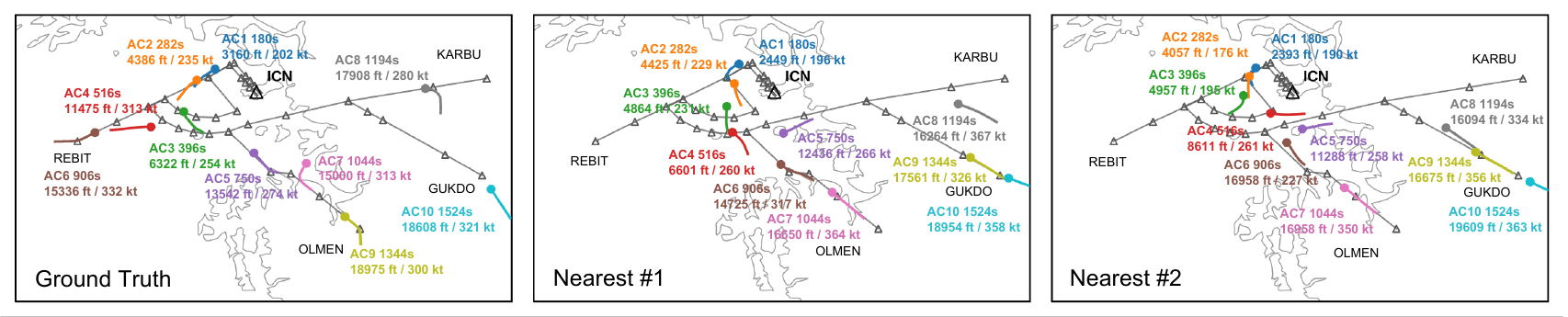
Recorded scene and the two generated samples closest to it under the same RTAs.

To assess whether DiTSG generates alternative traffic realizations under the same condition, we take the RTAs from a real scene and generate multiple scenes using those same RTAs. A useful generative model should represent the range of traffic scenes that could plausibly occur under a given condition, not the one scene that happened to be recorded. Shown here is the ground-truth recorded scene alongside the two generated samples closest to it; even these closest samples remain visibly different. The same RTAs and arrival sequence can therefore correspond to different plausible trajectory configurations, and DiTSG generates such alternatives rather than reproducing the recorded scene.

Agent Attention throughout the Denoising Process

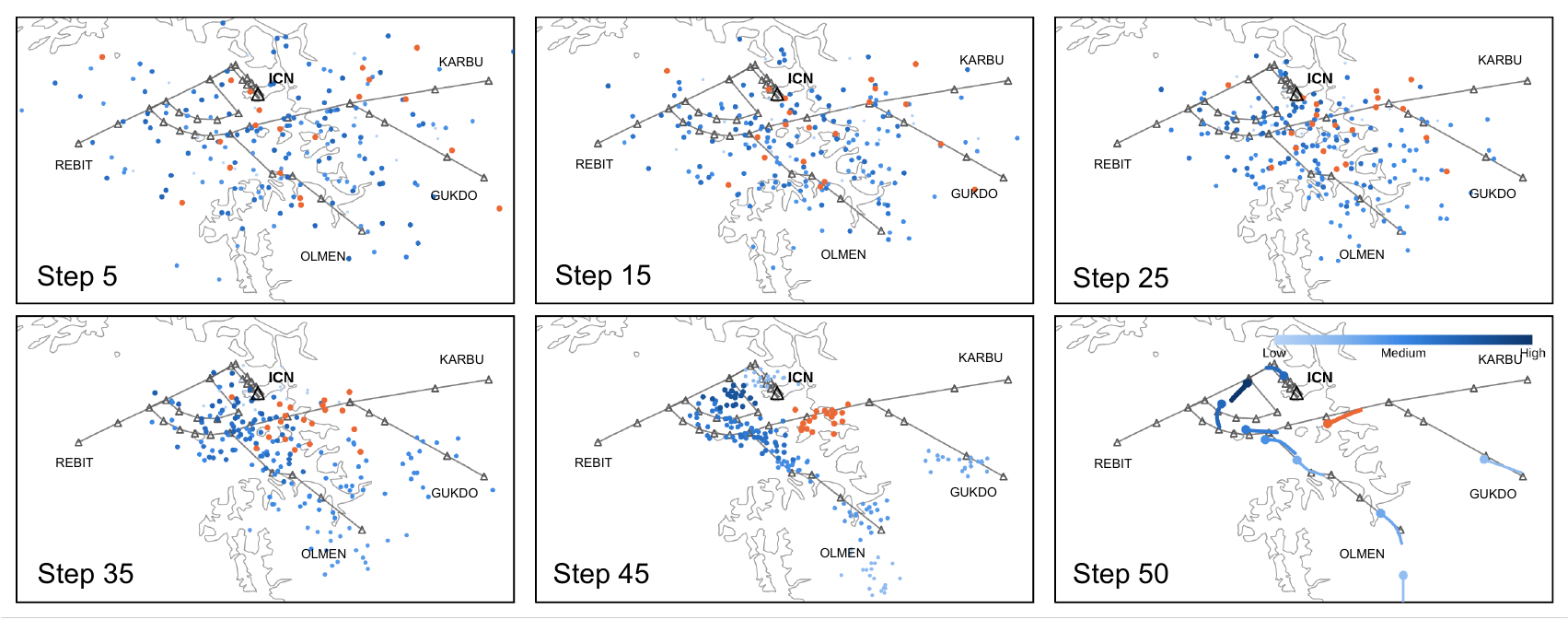
Agent attention from the query aircraft at six steps of the denoising process.

The query aircraft is shown in orange, while the others are colored according to the attention they receive from the query. Up to about step 25, the scores remain nearly uniform because the scene is still dominated by noise and little relational structure has emerged. As denoising progresses, the attention becomes more differentiated: the query assigns higher attention to aircraft ahead in the arrival sequence and lower attention to those behind. This behavior is consistent with arrival operations, where preceding aircraft often have a stronger influence on following traffic. DiTSG learns this interaction pattern directly during generation without explicit supervision on which aircraft should be attended to.

Quantitative Results

Evaluation of generated traffic scenes
MethodDocc ↓Rnov ≈ 1Diversity (NM)SVR (%) ↓
Real—1.000—0.000
MA-VAE0.0330.94716.6900.250
DiTSG0.0150.95314.9380.101

Metrics capture spatial fidelity, novelty relative to unseen real scenes, variation under a fixed condition, and separation violations; lower is better for Docc and SVR.

DiTSG and the Multi-Agent Variational Autoencoder (MA-VAE) use the same MAIFormer backbone, so their main difference lies in the generative formulation: flow matching versus variational latent modeling. DiTSG more than halves spatial occupancy divergence (0.015 vs. 0.033) and reduces the separation violation rate from 0.250% to 0.101%. The lower violation rate indicates closer agreement with the separation behavior observed in real traffic, which reflects the outcomes of real-world ATC operations. Novelty scores are close to the real-data reference of one for both DiTSG (0.953) and MA-VAE (0.947), indicating that both models generate scenes that remain distinct from the training data.

MA-VAE shows higher diversity than DiTSG, but higher diversity alone does not indicate better generation quality. Diversity should be interpreted together with spatial fidelity: MA-VAE also has substantially higher spatial occupancy divergence, meaning that some of its additional variation occurs farther from the spatial patterns observed in real traffic. DiTSG achieves slightly lower diversity while remaining substantially closer to the real traffic distribution, showing that it can still generate different plausible scenes without sacrificing fidelity. One possible explanation for the performance gap is the training-generation mismatch in MA-VAE: its encoder learns agent latents jointly from an observed scene, whereas those latents are sampled independently during generation. DiTSG instead learns and follows a joint velocity field over all aircraft, which may better preserve relationships among aircraft during generation.

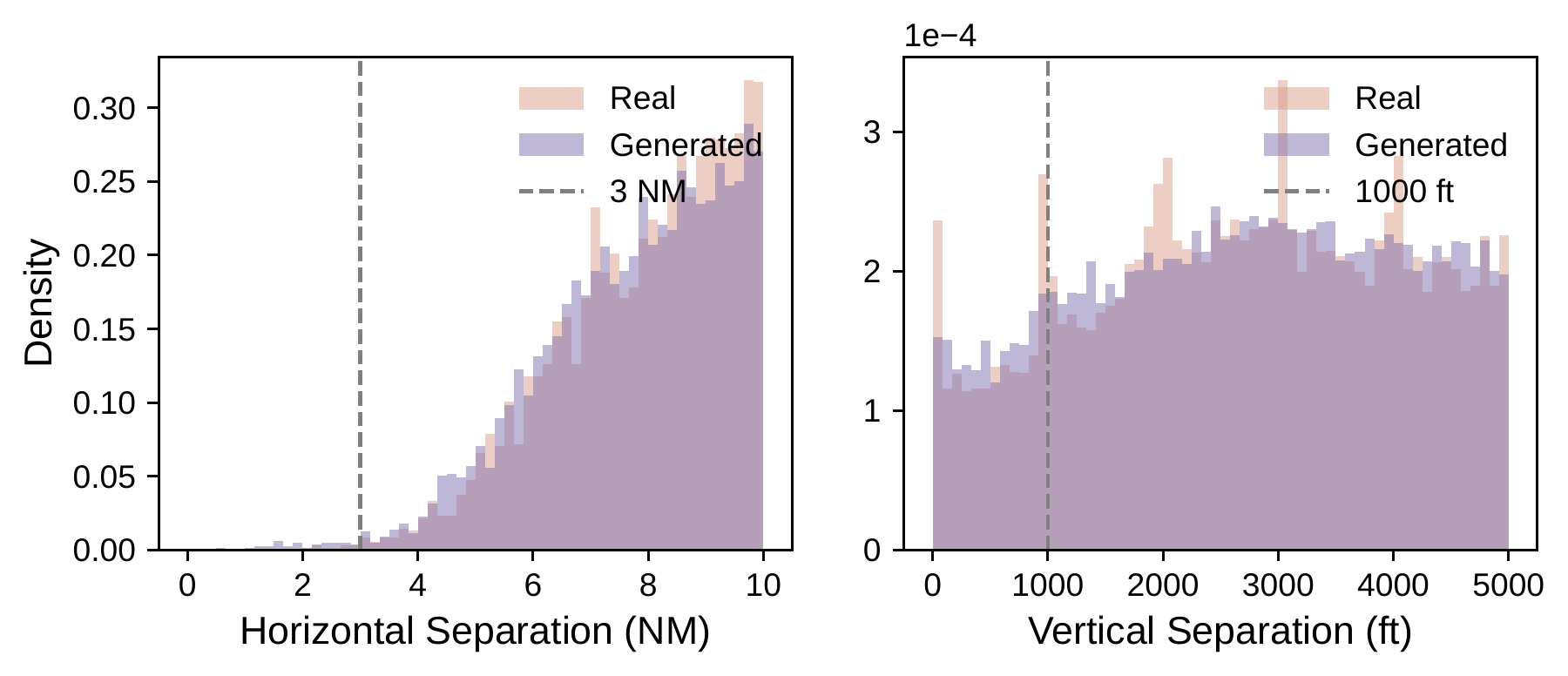
Real and generated minimum horizontal and vertical separation distributions, with reference thresholds at 3 NM and 1,000 ft.
Separation patterns in real and generated traffic.
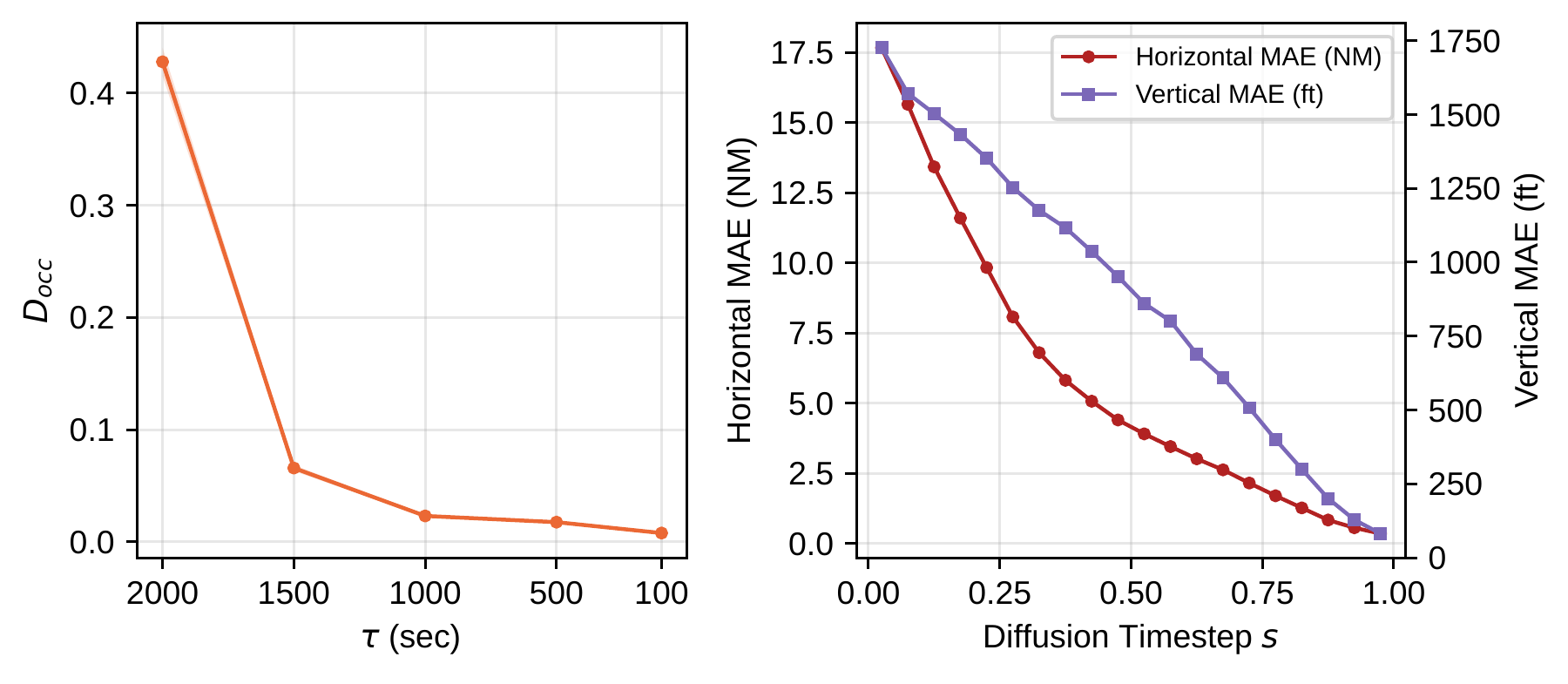
Spatial occupancy divergence versus arrival-time condition tau, and horizontal and vertical MAE over diffusion timestep s.
Traffic fidelity across arrival stages and diffusion timesteps.

The separation histograms further show that DiTSG reproduces the inter-aircraft spacing patterns observed in real traffic, beyond the single separation violation rate reported in the table. The real and generated distributions closely match for both horizontal and vertical separation. In the real data, aircraft pairs falling below the separation minimum are less frequent horizontally than vertically, indicating that horizontal separation is more consistently maintained in real-world ATC operations. DiTSG reproduces this same pattern, suggesting that it captures not only overall separation levels but also how spacing is maintained across aircraft.

The left panel groups aircraft by required time of arrival (τ) and computes Docc within each group, showing how closely generated traffic matches real traffic at different arrival stages. For τ below approximately 1,000 s, Docc remains near 0.02 with little variation as trajectories converge toward common arrival paths near the runway. The divergence increases mainly at larger τ, when aircraft are farther from the runway and can follow a wider range of plausible trajectories. The diffusion-time curves additionally show that horizontal and vertical position errors decrease as s approaches one, consistent with the traffic scene being progressively refined from noise throughout the denoising process.
BibTeX

@article{yoon2026ditsg,
  title={DiTSG: Context-Aware Air Traffic Scene Generation with Multi-Agent Diffusion Transformers},
  author={Yoon, Seokbin and Kim, Kyungmin and Kwon, Taejung and Lee, Keumjin and Wei, Peng},
  journal={arXiv preprint arXiv:2610.16959},
  year={2026}
}